
eSIM for IoT and Fixed Wireless Access
One eSIM.
Three US Carriers. Zero-Touch Control.
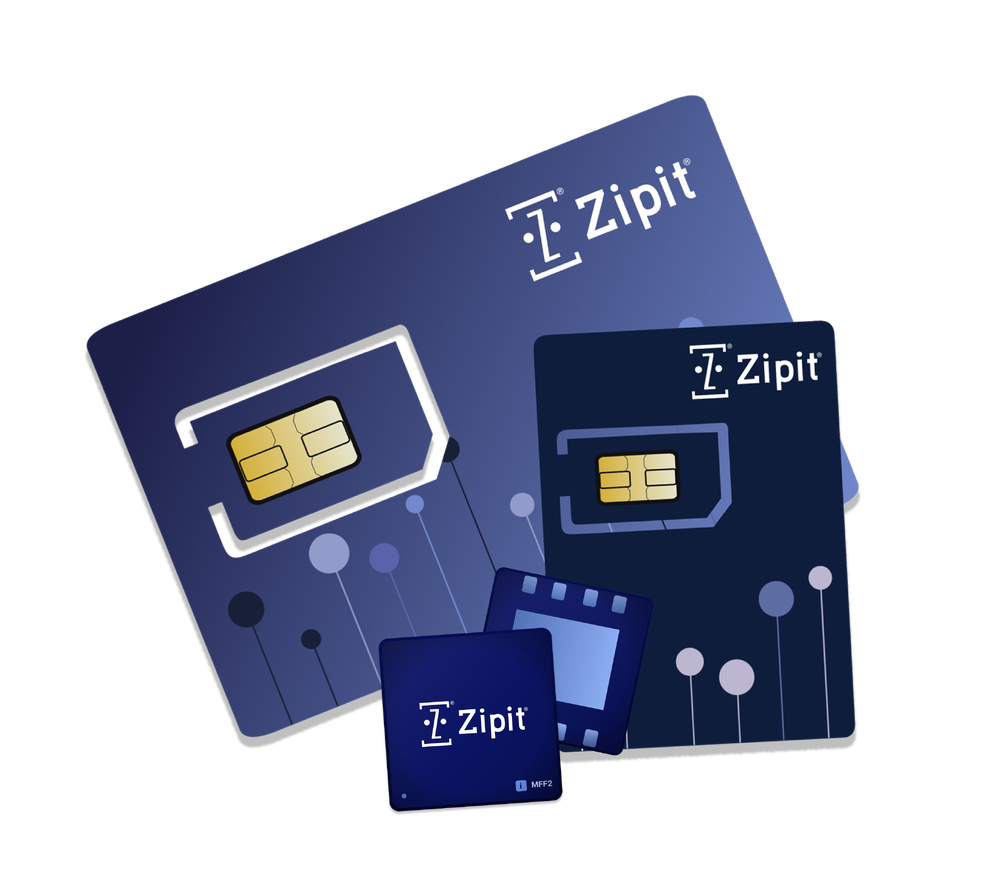
Learn about Zipit's new eSIM—available as a plastic card or embedded chip, purpose-built for the full spectrum of IoT needs—from low-power Cat-M1 sensors to high-bandwidth 5G deployments.
One Technology. Multiple Ways to Strengthen Your IoT Deployment.
Operational requirements and network conditions can change throughout an IoT deployment lifecycle of 3, 5 or even 10 years. As eSIMs have evolved from a simple embedded version of a carrier's plastic SIMs, the technology has turned connectivity from a fixed hardware decision during device manufacturing into a flexible, remotely managed capability.
This gives IoT product teams greater control over how devices connect across networks, regions, and stages of their lifecycle.
Click on each button below to learn how new eSIMs like Zipit's can expand coverage, enable network resilience, and simplify ongoing IoT operations.
A Purpose-Built eSIM for a Multi-Carrier, Multi-Network World
Zipit eSIM Integrated is an eUICC with four certified, pre-loaded profiles from AT&T, Verizon, and T-Mobile managed by an eIM and IoT Profile Assistant embedded directly in the SIM (IPAe), as defined in the most recent SGP.32 eSIM standards.
This allows OEMs, enterprises and IoT solution developers to get the benefits of connecting to multiple carrier networks and remotely changing the active profiles, without the complexity of stocking multiple SIM types or physically swapping out carrier SIMs.
It's a single SIM that adapts to your needs.
Native Access to All Three Major U.S. Carriers
Certified, on-net connectivity profiles from AT&T, Verizon, and T-Mobile provide native U.S. network access without limiting the deployment to a single carrier relationship or forcing you to stock and manage different carrier-specific SIMs. As an authorized MVNO of all three carriers, Zipit can offer plan sizes from the KBs up to Unlimited plans.
Automatic Failover Built Into the SIM
Automatic Failover provides an alternative connectivity path when the primary carrier is unavailable. Because the switching capability is handled within the SIM solution, product teams do not have to design carrier-switching logic into device firmware.
Connectivity Without Technology Tradeoffs
Support for cellular technologies from Cat-M1 through 5G helps product teams select connectivity based on device requirements and lifecycle goals.
On-net access (also called "native" or "localized" connectivity) ensures customers' devices can access the different plans or features they need—from very high data usage FWA or Unlimited plans to eDRX functionality to maximize battery life, to VoLTE and SMS for IoT devices like wearables or security call boxes. These capabilities are often unavailable or uneconomical when sourced through standard roaming agreements.
Centralized Device Management
Zipit’s unified connectivity management platform gives teams a common operational layer for managing profiles, connectivity policies, plan options and more across otherwise separate carrier environments. Carrier backend systems are managed through a single pane of glass, simplifying connectivity orchestration and lifecycle control across deployments.
Key Features & Specifications
Features
-
4 Native Profiles
-
Global Roaming Internationally
-
Automatic Profile Failover
- Available Rate Plans from 250KB to Unlimited from all 3 Carriers
GSMA Standards
- SGP.32 v1.1
- SGP.22 v2.5
Form Factors
-
TriCut (Mini, Micro, Nano)
- MFF2 (Embedded)
Technologies Supported
- 5G, 5G RedCap
- 4G LTE, LTE Cat 1 bis
- LTE-M, Cat-M
- NB-IoT
A Trusted Source of Managed Connectivity
For nearly two decades, Zipit has helped businesses launch and scale cellular IoT offerings around the world that deliver improved customer experiences and unlock new revenue streams.
15+ Years
Proven Track Record
More than 15 years of MVNO experience, helping OEMs and enterprises launch, manage, and scale cellular-connected products, including guidance on how to package and charge for connectivity to support profitable growth.
5 Continents
Global Experience
We have hands-on experience supporting connected products across five continents, with connectivity strategies built for diverse markets and network requirements.
$50M+
Strategic Impact
We've enabled more than $50 million in recurring IoT revenue through connected-product launches, scalable deployment strategies, and connectivity monetization guidance.
Discover the Impact of a Zipit Partnership.
Learn how Zipit's offerings, including eSIM technology, are helping companies like Device Solutions to better serve customers and future-proof their deployments.
Success Stories Powered by Zipit
Hylio
Watch Video
Smartcom
Read Story
Magnadyne
Read Story

BrightSign
Read Story

Bushnell
Read Story
FAQs about Zipit eSIMs
Get answers to common questions about Zipit eSIM Integrated.
Do I need to do anything special in my device to support Zipit eSIM Integrated?
No. To use Zipit eSIM Integrated, all of the logic for profile management and carrier management is available on the SIM and from the Zipit connectivity management platform.
For advanced device OEMs and solution developers that build their own device firmware and want even more advanced, granular control over carrier management, Zipit has made enhancements to its platform to support this. Contact us for details.
Does Zipit eSIM Integrated require additional certifications?
Zipit eSIM Integrated uses native carrier profiles from AT&T, Verizon and T-Mobile, and therefore requires that your devices have undergone carrier certification. We do not require additional certifications beyond those of the carriers.
To learn more about the process of carrier certification, visit our blog post on the topic.
What is the difference between on-net/native SIMs and roaming SIMs?
Roaming SIMs leverage a given carrier's roaming agreements to hop onto other carriers' networks in different geographies where the primary carrier doesn't have a physical infrastructure presence.
On-net refers to in-region or a local carrier's network. A local or "on-net" SIM is one that is authorized to connect to a carrier's network without the need for roaming agreements. Many carriers around the world put restrictions on some roaming SIMs to prevent unintended and unauthorized use.
As a multi-carrier provider with many direct carrier relationships, Zipit can be a single source for customers looking for authorized roaming SIMs as well as local SIMs for their IoT and FWA applications. Read more here.
Why does Zipit eSIM Integrated have three carriers, but four profiles?
AT&T has two profiles. Verizon and T-Mobile have one each.
All four profiles have been pre-loaded in order to support every feature and service Zipit and these carriers offer within a single eSIM. That covers networks from Cat-M1 to 5G, and rate plans from 250KB all the way up to Business Internet/Fixed Wireless and Unlimited plans. It also includes VoLTE and SMS support for IoT applications, which many eSIMs don't offer.
The objective was to create a single eSIM that could meet the broadest range of customer needs across many different device types and data-usage patterns.
Recommended Resources
Learn more about IoT eSIMs and global connectivity strategies from the experts.
GSMA SGP.32 is a transformative standard designed to streamline e...
For years, international IoT deployments operated on the simple a...

GSMA SGP.32 foretold a revolution in the IoT ecosystem, with IoT ...