IoT Device Lifecycle Management: From Production to Monetization


- November 2026 (1)
- October 2026 (5)
- September 2026 (3)
- August 2026 (2)
- July 2026 (3)
- June 2026 (3)
- May 2026 (1)
- April 2026 (2)
- March 2026 (3)
- February 2026 (2)
- January 2026 (2)
- December 2025 (2)
- November 2025 (2)
- October 2025 (2)
- September 2025 (3)
- August 2025 (3)
- July 2025 (1)
- June 2025 (3)
- May 2025 (2)
- April 2025 (3)
- March 2025 (2)
- February 2025 (1)
- December 2024 (2)
- November 2024 (1)
- August 2024 (2)
- June 2024 (3)
- May 2024 (2)
- April 2024 (1)
- March 2024 (3)
- February 2024 (2)
- January 2024 (2)
- December 2023 (1)
- November 2023 (2)
- October 2023 (2)
- September 2023 (1)
- August 2023 (1)
- July 2023 (2)
- June 2023 (2)
- May 2023 (1)
- March 2023 (4)
- January 2023 (2)
- November 2022 (1)
- September 2022 (1)
- August 2022 (2)
- July 2022 (2)
- June 2022 (1)
- May 2022 (1)
- April 2022 (3)
- March 2022 (1)
- February 2022 (3)
- January 2022 (2)
- December 2021 (1)
- November 2021 (1)
- October 2021 (2)
- September 2021 (3)
- August 2021 (1)
- July 2021 (3)
- May 2021 (2)
- April 2021 (2)
- March 2021 (1)
- February 2021 (3)
- January 2021 (3)
- December 2020 (1)
- October 2020 (1)
- August 2020 (1)
- August 2019 (1)
- January 2019 (2)
- September 2018 (5)
- June 2018 (1)
- November 2017 (1)
- September 2017 (1)
- July 2017 (1)
- May 2017 (1)
- January 2017 (1)
- October 2016 (2)
- August 2016 (1)
- July 2016 (1)
- June 2016 (1)
Subscribe by email
IoT device lifecycle management is the end-to-end discipline of managing a connected device from production and SIM provisioning through deployment, activation, ongoing billing, suspension, and eventual retirement. For OEMs and connected product companies, it is both a technical and commercial responsibility. When IoT lifecycles are planned well, devices activate cleanly, subscriptions generate predictable revenue, and support costs stay manageable.
In this article, we’ll explain what IoT device lifecycle management encompasses, where companies often underestimate complexity, and how to build a connected product strategy that protects recurring revenue from the production line through retirement.
Key Takeaways:
IoT device lifecycle management begins at production and continues through retirement. Effective management covers SIM provisioning, carrier registration, activation, usage monitoring, billing, suspension, and decommissioning.
Connectivity and monetization should be planned before devices ship. OEMs need to establish when subscriptions begin, who pays for connectivity, and how billing changes throughout the device's lifetime to protect recurring revenue and profitability.
Centralized connectivity and billing management reduces operational complexity. Connecting SIM status, device activity, data usage, and subscription billing helps prevent activation failures, unnecessary connectivity charges, and revenue leakage.
Seasonal devices and multi-carrier deployments require flexible lifecycle management. Automated suspension, reactivation, usage-based billing, and centralized carrier management help OEMs control costs and simplify operations as deployments scale.
eSIM technology simplifies long-term connectivity management. Solutions like Zipit eSIM Integrated enable OEMs to manage multiple carrier profiles, support network failover, and make connectivity changes remotely without replacing physical SIM cards.
What is IoT device lifecycle management?
IoT device lifecycle management is the end-to-end process of managing connected devices across every operational stage. Device lifecycle management starts long before devices ever reach the hands of a customer. The lifecycle begins when the device is manufactured, tested, assigned connectivity, prepared for carrier activation, and built into a commercial model.
It encompasses every decision and workflow that determines whether a device can connect reliably, activate successfully, generate recurring revenue, and remain profitable throughout its lifetime. That is why IoT lifecycle management must account for questions such as:
- Which carrier or carriers will support the device?
- Which SIM or eSIM strategy is best for the product?
- How will the device be tested during production?
- When does connectivity billing begin?
- How does a customer activate the product?
- What happens if the device is inactive for several months?
- How are SIMs suspended, reactivated, transferred, or retired?
- How does the company prevent connectivity costs from continuing after customer revenue ends?
When these questions are addressed early, connected IoT OEMs can create a more reliable customer experience and a more sustainable recurring revenue model.
When they are ignored, lifecycle management becomes a reactive process driven by support tickets, carrier invoices, spreadsheet tracking, and avoidable margin loss.
IoT lifecycle management starts on the production line
IoT device lifecycle management is happening on the production line, requiring companies to plan and strategize proactively. For example, the SIM goes into the device during assembly. The device connects to a network for diagnostics. The IMEI gets captured. The carrier gets notified. These are lifecycle events, and the decisions made at this stage determine whether devices activate cleanly six months later when a customer finally opens the box.
Manufacturing diagnostics and SIM provisioning
During production, a SIM is inserted into the device, and manufacturing diagnostics confirm that everything is functioning correctly. Those diagnostics typically verify:
- Whether the device can connect to the cellular network
- Whether it can read the SIM card
- What the ICCID is
- What the IMEI is
- Whether the device is compatible with the intended carrier
Once diagnostics are complete, the device is powered down and prepared for shipment and customer acquisition. However, the SIM provisioning and production-line testing that happened at the start of that journey are what make the eventual activation possible.
Carrier registration and IMEI capture
Depending on the carrier, region, and deployment model, a cellular IoT device may need its IMEI registered or whitelisted with the carrier before a customer can activate it. This tells the carrier what kind of device is being activated, like a trail camera, a sprinkler controller, or a fleet router, and confirms it is authorized on the network.
Some OEMs automate this step as part of their production workflow. Others complete a production run and then batch-upload a spreadsheet of IMEIs to the carrier. Either approach works, but where registration is required, it must happen before the customer activation event. If it does not, activation or network-attach issues may result, and support calls follow.
The shipping and inventory gap
Companies need deliberate control over when a SIM becomes active and when billing begins. Between production and customer activation, there is a window that can span weeks or months. Devices are in transit, sitting in distribution centers, or waiting on retail shelves. During this period, connectivity costs should not be running.
A SIM that is provisioned but not yet active should not be generating charges. Managing this window cleanly (knowing which SIMs are provisioned, which are in transit, and which are ready for customer activation) is an early test of whether a company's IoT SIM management infrastructure is firmly in place.
For companies managing multiple carriers or regional deployments, this is also where a centralized connectivity management platform can remove substantial operational overhead. Having one system to manage SIM status, activations, and reporting creates the visibility needed to control costs before devices ever reach the customer.
Lifecycle stages after the device ships
The IoT device lifecycle spans from production through customer activation, ongoing use, and eventual retirement. Each stage has distinct operational and commercial requirements. Managing them well requires tools that unlock visibility and control at every step.
Customer activation and subscription start
Activation is the moment a device transitions from inventory to revenue. A well-designed activation workflow lets the customer self-activate through a branded portal or app. This app captures billing information, starts the subscription, and provisions the SIM, all without a support call. The device connects, the customer selects a plan, and automatic billing begins.
Consumer carrier activation flows are built for phones and tablets. They may require the customer to visit a store, call a carrier, or respond to an SMS that an IoT device cannot receive or display. When OEMs leave activation to the carrier or the end user, they lose control of the experience and inherit the support consequences when it breaks.
Ongoing usage and connectivity monitoring
After activation, the operational work continues. Companies need visibility into:
- Data usage per device to catch overages before they become billing problems
- Plan alignment to confirm devices are on the right plan for their actual usage
- Device connectivity status to identify devices that have gone offline
- Billing state to confirm active subscriptions match active devices
Without centralized visibility across all of these simultaneously, fleet management becomes reactive.
Suspension, reactivation, and seasonal use
Not every device runs continuously. Seasonal and intermittent devices need service paused, resumed, and billed correctly without manual work at each step. The seasonal devices section below covers this in detail.
Device replacement and line transfers
Devices fail, get damaged, or need to be upgraded. When that happens, the customer's subscription should not be disrupted. The workflow typically involves deactivating the SIM in the old device, activating a new SIM in the replacement, and transferring the line and account details so billing continues without interruption.
Without a clear process for line transfers and SIM changes, replacements create gaps in service, billing errors, or duplicate charges.
Retirement and decommissioning
End-of-life management requires canceling plans, deactivating SIMs, stopping billing, and removing inactive devices from operational records. This is where many companies accumulate what are sometimes called "zombie devices". Zombie devices are SIMs that remain on active, chargeable plans after the customer relationship has ended.
At a small scale, zombie devices are an annoyance. At fleet scale, they represent a compounding cost and driver of revenue leakage. If a company cannot confirm which devices are still generating revenue and which are simply generating charges, it cannot calculate margin accurately and cannot act on the problem systematically.
Where IoT OEMs underestimate lifecycle complexity
The most expensive lifecycle problems follow predictable patterns, and most of them trace back to decisions that were made early in the product development process.
Leaving SIM selection and APN configuration to the end user
When an OEM ships a device without a bundled SIM or a defined activation path, the end user is left to figure out connectivity on their own. That typically means visiting a carrier store, selecting a plan without knowing what the device actually needs, and then attempting to configure the device manually.
The APN problem is a specific and recurring failure point. APNs differ by provider. An AT&T SIM sold through one channel may require a different APN than one sold through another. If the end user does not know which APN to enter (or does not know what an APN is) the device will not connect. The customer then calls the OEM, which now owns a support problem it did not create and cannot easily diagnose.
This is one reason many connected solutions companies choose to design connectivity from the start with deliberate multi-carrier cellular connectivity solutions, rather than leaving SIM sourcing, plan selection, and configuration to the customer. It gives you more control over activation, support, and long-term lifecycle consistency.
From our experience: How Magnadyne learned consumer carrier workflows don't fit IoT devices
Magnadyne, one of our clients, encountered a version of this problem. Customers would purchase a router from Magnadyne and then bring a SIM they purchased from AT&T. AT&T's activation system, which is designed primarily for phones and tablets, may attempt to send an SMS as part of the activation process. A router cannot receive and display that SMS in the way the carrier expects. In some cases, the SIM would not activate.
The customer would call Magnadyne. Magnadyne had no visibility into the customer's carrier account, no ability to diagnose the carrier's activation flow, and no way to resolve the issue. The product worked, but the connectivity strategy encountered unexpected real-world challenges. And because the OEM's name was on the device, the OEM owned the problem.
Disconnected billing and device status
When device status, SIM status, usage data, plan details, and customer billing live in separate systems, the gaps between them create risky financial exposure. Devices go over plan limits without alerting users or OEMs. Usage can get billed to the wrong account, or in some cases, customers stop paying but devices stay active.
When connectivity operations and billing are coordinated through a single connectivity management platform and an IoT-specific billing platform, you can tie device state, SIM activity, usage, and revenue together instead of reconciling them manually across disconnected systems.
Learn more: OSS/BSS in Telecom: A Comprehensive Guide for IoT Applications
Connectivity and the device: a unified customer experience
Customers do not distinguish between the device and the connectivity. They bought a connected product. When the connection fails, the customer calls the company whose name is on the box, not the carrier, not the network operator, not the SIM vendor. The OEM owns the customer relationship, and that relationship includes connectivity. If connectivity was not designed into the product from the beginning, every failure in the field becomes an OEM support issue.
The companies that recognize this early build connectivity into their activation workflow, their billing model, and their support infrastructure. The companies that do not can spend years managing consequences that were preventable. Zipit Wireless works with OEMs to make connectivity part of that broader product strategy, combining global IoT deployments, carrier coordination, and operational visibility through a single pane of glass rather than forcing teams to manage the experience in fragments.
How IoT lifecycle management connects to monetization
The decisions made about who pays for connectivity, when billing starts, what happens after a bundled period ends, and how seasonal devices are handled all determine whether a connected product is profitable at scale.
Who pays for connectivity, and when
The foundational monetization questions need answers before a device ships:
- Is connectivity bundled into the hardware price, or does the customer pay for it separately?
- When does the subscription start? This could be at activation, at purchase, or after a trial period.
- Can the customer take over payment responsibility after a bundled period ends?
- What happens to billing if a device is suspended?
These are product strategy decisions. Companies that can design activation flows, billing systems, and customer communications that support the intended model position themselves for competitive longevity.
Protecting margin as devices outlive their data plans
The tension between the life of the device and the life of the paid data plan creates underestimated margin risks in IoT deployments.
A device designed to last seven years with a three-year bundled connectivity plan creates a four-year gap. The OEM absorbs the ongoing connectivity costs if they have not established a path for the customer to take over the subscription or a mechanism to deactivate the SIM when the paid period ends. Planning the transition upfront is far less expensive than managing it after the fact.
At tens of thousands of devices, even low per-device data costs become a material expense. Without a transition plan, the OEM either absorbs the cost, forces a service shutdown, or scrambles to add a subscription model that should have been there from the beginning.
Seasonal devices: strategic planning around diverse data needs
Most lifecycle frameworks assume continuous operation. But many IoT devices do not follow that pattern, and the gap between how lifecycle tools are designed and how seasonal devices actually behave is where costs can accumulate quietly.
A farming device may be active during spring planting and again in early fall, then dormant for months at a time. An outdoor trail camera may run through hunting season and sit unused the rest of the year. A mobile surveillance van at a construction site may be active for the duration of a project and then pulled entirely for an unknown number of months.
For these devices, lifecycle management must support:
- Pausing service without canceling the subscription
- Reactivating service cleanly when the season or project resumes
- Seasonal and usage-based billing that reflects actual activity
- Customer notifications around renewal, reactivation, and plan changes
- Device status tracking that distinguishes between intentionally inactive and truly offline
- Avoiding connectivity charges during inactive periods
A device with a six- or seven-year lifecycle may cycle through this pattern a dozen or more times. Each pause-and-resume event is a lifecycle transaction. If those transactions require manual intervention, the operational overhead compounds over time and across the fleet.
The billing model matters here just as much as the operational tooling. A flat monthly subscription that charges the same rate whether a device is active or dormant forces OEMs to either absorb costs during inactive periods or push customers toward cancellation. Neither outcome supports long-term retention. Usage-based plans and seasonal billing structures address this directly, but they require a billing platform designed to handle non-linear usage patterns from the start.
For OEMs trying to turn connected products into subscription-based IoT services, this is where purpose-built monetization infrastructure becomes critical. Zipit’s billing platform ties billing to SIM and device activity, making it easier to automate renewals, plan changes, suspensions, and reactivations without building those workflows internally.
Multi-carrier connectivity: another layer of lifecycle complexity
Single-carrier deployments are operationally straightforward until coverage gaps, network sunsets (the US 2G and 3G shutdowns are already complete), or geographic expansion make them untenable. Many connected product companies eventually need more than one carrier. When that happens, the operational overhead of managing those relationships independently scales poorly.
Each carrier brings its own contract, activation workflow, APN configuration, billing cycle, support team, and management portal. What was manageable with one carrier becomes a coordination burden with three or four. Teams spend time reconciling invoices, logging into separate platforms, and routing support escalations to the right carrier, none of which adds value to the product or the customer.
The table below illustrates how the operational picture changes as carrier count grows, with and without a centralized platform:
|
Operational Dimension |
Single-Carrier Management |
Multi-Carrier Management Without a Platform |
Multi-Carrier Management With a Platform |
|
Carrier contracts |
One relationship |
Multiple negotiations and renewals |
One agreement, multiple carriers behind it |
|
Activation workflows |
One process |
Separate workflows per carrier |
One activation flow across carriers |
|
Billing and invoicing |
One invoice |
Multiple billing cycles and reconciliation |
One consolidated invoice |
|
Support escalations |
One point of contact |
Multiple carrier support teams |
One point of contact |
|
Coverage flexibility |
Limited to one network |
Broader coverage, higher coordination cost |
Broader coverage and failover, no extra coordination |
|
Platform visibility |
One portal |
Multiple portals, no unified view |
One portal across all carriers |
Broader coverage and network redundancy are legitimate operational advantages when managed through a single platform and partner that has already established carrier relationships, integrated carrier back-end systems, and consolidated billing and support into one interface.
That is the operational value of Zipit's global cellular connectivity. Zipit gives OEMs access to Tier-1 carrier partnerships, multi-network connectivity, and native connectivity and global roaming options without building and managing that carrier ecosystem themselves.
How eSIM simplifies multi-carrier lifecycles
With a traditional SIM, the carrier is chosen at assembly and stays fixed for the life of the device. For a product expected to run six or seven years, that is a hard decision to undo. An eSIM built on GSMA's SGP.32 IoT specification can hold more than one carrier profile and switch between them remotely, with no SIM swap or field visit.
That changes several lifecycle stages at once:
- Production: one SKU can ship to every market, so the carrier doesn’t have to be decided on the line.
- Coverage and failover: if the primary network drops, the device can fall back to another carrier profile.
- Network sunsets and contract changes: moving a fleet to a different carrier becomes a remote profile change instead of a device replacement.
- Retirement: profiles can be disabled remotely when a device reaches end of life, so it stops generating charges.
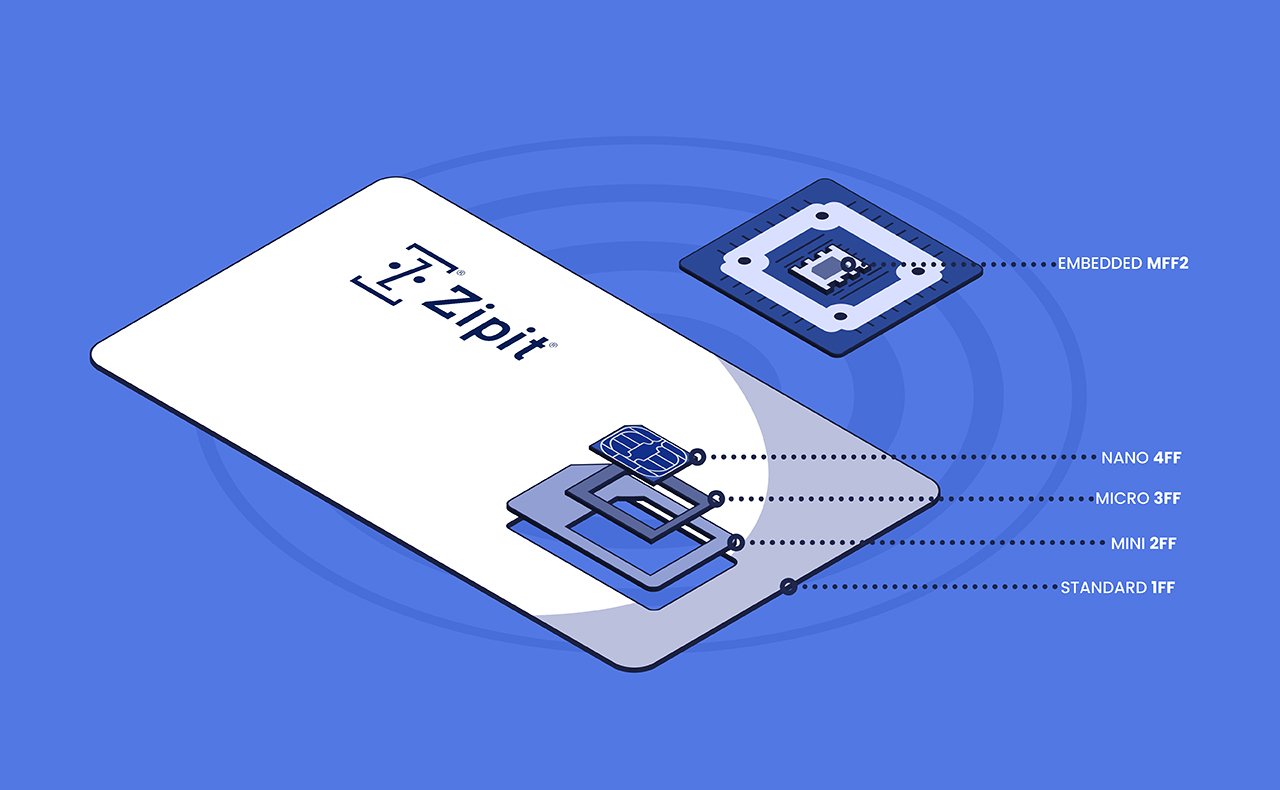
Zipit eSIM Integrated ships with native AT&T, Verizon, and T-Mobile profiles pre-loaded on an SGP.32 eUICC, with automatic failover between them. It comes in industrial Tri-Cut and MFF2 form factors and supports Cat-M1 through 5G.
9 capabilities to look for in an IoT lifecycle management platform
If you are evaluating whether your current tools and partners can support the full device lifecycle, these are the capabilities that matter most. The gaps in this list are where activation failures, billing leakage, and support escalations tend to originate.
1. SIM and eSIM provisioning built into the production workflow
Provisioning should be part of the production line. Look for a platform that supports SIM and eSIM insertion, network attach confirmation, ICCID reading, and IMEI capture during manufacturing diagnostics, so devices are ready for clean activation from the moment they leave the factory. eSIM support matters more each year: the Trusted Connectivity Alliance estimates that 605 million eSIMs shipped in 2025, up 18%, and IoT deployments are moving toward GSMA’s SGP.32 specification.
2. Carrier registration and IMEI management
Where required by the carrier or deployment model, devices using cellular connectivity may need their IMEIs registered or whitelisted before a customer can activate them. The platform should support this process, whether automated during production or batch-uploaded after a production run, and maintain accurate records of which devices are registered and with which carriers.
3. Activation workflows designed for IoT devices
Consumer carrier activation flows are built for phones. IoT devices need activation paths that are purpose-built: self-service portals or apps that capture billing information, provision the SIM, start the subscription, and confirm connectivity, without requiring the customer to contact a carrier or configure an APN manually.
4. Multi-carrier connectivity from a single platform
Managing multiple carriers through a single interface reduces the operational overhead of separate contracts, portals, and support teams. The platform should have pre-built integrations with major carriers across the geographies where your devices are deployed, so adding a new carrier does not require rebuilding your management infrastructure.
5. Usage monitoring and data visibility across the fleet
Connectivity management platforms should surface data usage per device, flag devices approaching plan limits, identify devices that have gone offline, and give operations teams a real-time view of fleet status, across all carriers, in one place.
6. Subscription and usage-based billing tied to device state
Billing should reflect the nuanced behavior of the device. Subscriptions should start when a device activates, usage-based plans should bill on actual consumption, and billing should pause or adjust when a device is suspended. A platform that cannot tie billing state to device state creates the conditions for both revenue leakage and unnecessary cost.
7. Seasonal and intermittent device support
Seasonal devices need more than a pause button. Look for support for seasonal billing structures, usage-based plans, subscription renewal workflows, and customer notifications around reactivation. A platform that treats seasonal devices the same as always-on devices will generate unnecessary costs and friction at every cycle.
8. API integration with your existing systems
The platform should offer APIs that connect to your existing software, whether that is a CRM, ERP, customer portal, or billing system. Device state, SIM status, usage data, and billing information should flow between systems without manual reconciliation.
9. End-of-life SIM deactivation and subscription offboarding
When a customer relationship ends, the platform should make it straightforward to cancel the plan, deactivate the SIM, and remove the device from active operational records. Without this, inactive devices accumulate on chargeable plans, a direct and ongoing margin cost.
IoT device lifecycle management with Zipit Wireless
Zipit Wireless helps connected product companies manage the operational and commercial lifecycle of IoT connectivity.
Zipit is more than a connectivity provider. It acts as the lifecycle strategy partner behind connected products. That includes cellular connectivity access, multi-carrier planning, SIM and eSIM strategy, carrier coordination, device activation, subscription and usage-based billing, seasonal suspension and reactivation, data usage visibility, consolidated billing, and ongoing support.
Zipit's engagement model can begin before manufacturing, so connected product companies can make critical decisions about carrier selection, SIM strategy, activation design, and monetization before devices reach production. This includes consolidated billing across carriers, data usage visibility, and ongoing support.
This helps OEMs avoid costly lifecycle problems later, when devices are already in the field, and customer expectations are already set.
With Zipit, companies can design connectivity into the product experience from the start, centralize lifecycle controls, simplify multi-carrier operations, and build recurring revenue models that are easier to manage as fleets scale.
Contact Zipit to learn how we can help you build a scalable connected product strategy.
You may also like:
Related Content
The latest IoT insights and platform updates from Zipit.
Choosing the wrong SIM for an IoT deployment can cost OEMs time, money, and long-t...
Everyone in IoT is talking about eSIM. For OEMs, that conversation often starts wi...

In a world increasingly populated by smart devices and real-time data, reliable, s...